Blog
How to Teach Phonemic Awareness With Engaging Activities
Learn how to teach phonemic awareness using fun, practical, and evidence-based activities that build essential pre-reading skills in young children.
Teaching phonemic awareness is all about playful, ears-only activities that tune a child into the individual sounds, or phonemes, in spoken words. The best way I've found to do this is through short, daily, game-like lessons that feel more like fun than work. We're talking about blending sounds together (/c/ /a/ /t/ makes 'cat') and splitting words apart into their separate sounds.
Why Phonemic Awareness Is the Bedrock of Reading
Before we jump into the fun and games, it’s really important to grasp why this skill is the non-negotiable first step in learning to read. Phonemic awareness is a purely auditory skill. It has absolutely nothing to do with letters on a page and everything to do with a child's ability to hear and play with the smallest sounds in our language.
Think of it like this: a child can’t connect a sound to a letter if they can’t even hear that individual sound in the first place. This is the "ear training" that prepares the brain for decoding and makes all other reading skills, like phonics, possible.
The Auditory-to-Visual Connection
The journey to reading truly begins with the ears, not the eyes. A child first learns to hear and isolate the starting sound in "sun" as /s/ long before they can reliably connect it to the letter S. This ability to tune into discrete sounds is what makes phonics instruction finally click for them.
When you teach phonemic awareness, you're building mental hooks where letter-sound knowledge can later attach. Without this groundwork, asking a child to "sound out a word" is like asking them to build a house without a foundation—the pieces just won't come together.
"Phonemic awareness is the most potent predictor of success in learning to read." - Marilyn Jager Adams, Ph.D.
This isn't just a nice theory; it's one of the most solid findings in literacy research. A child's skill in these simple oral sound games is a powerful predictor of their long-term reading comprehension.
Backed by Research
The link between a child's early phonemic skills and their later reading ability is incredibly strong and well-documented. For instance, research has shown that first-graders with strong phonological awareness were far more likely to pass their third-grade reading tests.
One study I often think about highlighted a 71% pass rate for students with high phonemic skills—a huge difference compared to their peers who struggled with these foundational auditory abilities.
This evidence makes it clear: spending time on sound play isn't just filler. It's a powerful investment in a child’s future. These auditory skills are often naturally developed through shared reading, which is just one of the many benefits of reading to your child.
Key Distinctions to Remember
It’s easy to get these terms mixed up, but knowing the difference helps you be much more intentional in your teaching.
Phonological Awareness: This is the big, broad umbrella of sound skills. It includes things like rhyming, clapping out syllables in a name, and hearing individual words in a sentence.
Phonemic Awareness: This is a specific, more advanced piece of the puzzle. It focuses only on the smallest individual sounds (phonemes) within a single word.
So, all phonemic awareness tasks are phonological, but not all phonological tasks are phonemic. Knowing that "cat" and "hat" rhyme is a phonological skill. Knowing that "cat" is made of three distinct sounds—/c/, /a/, /t/—is a phonemic skill. Our goal is to guide children from those broader skills toward this more refined, laser-focused listening.
The Natural Progression of Phonemic Awareness Skills
Teaching phonemic awareness isn't about throwing a bunch of sound games at a child and hoping something sticks. There’s a natural, predictable order to it. Just like a baby learns to sit up before they crawl, a child needs to master simpler sound skills before they can tackle the more complicated ones.
Trying to teach a child to swap sounds in a word before they can even hear the first sound is a recipe for frustration—for both of you. By understanding the developmental ladder, you can meet your learner exactly where they are and guide them to the next rung with confidence.
It's a journey that starts with the ears and ends with the eyes on a page. First, they learn to hear the sounds. Then, they learn to link them together. Finally, this auditory skill connects to printed letters, and they begin to read.
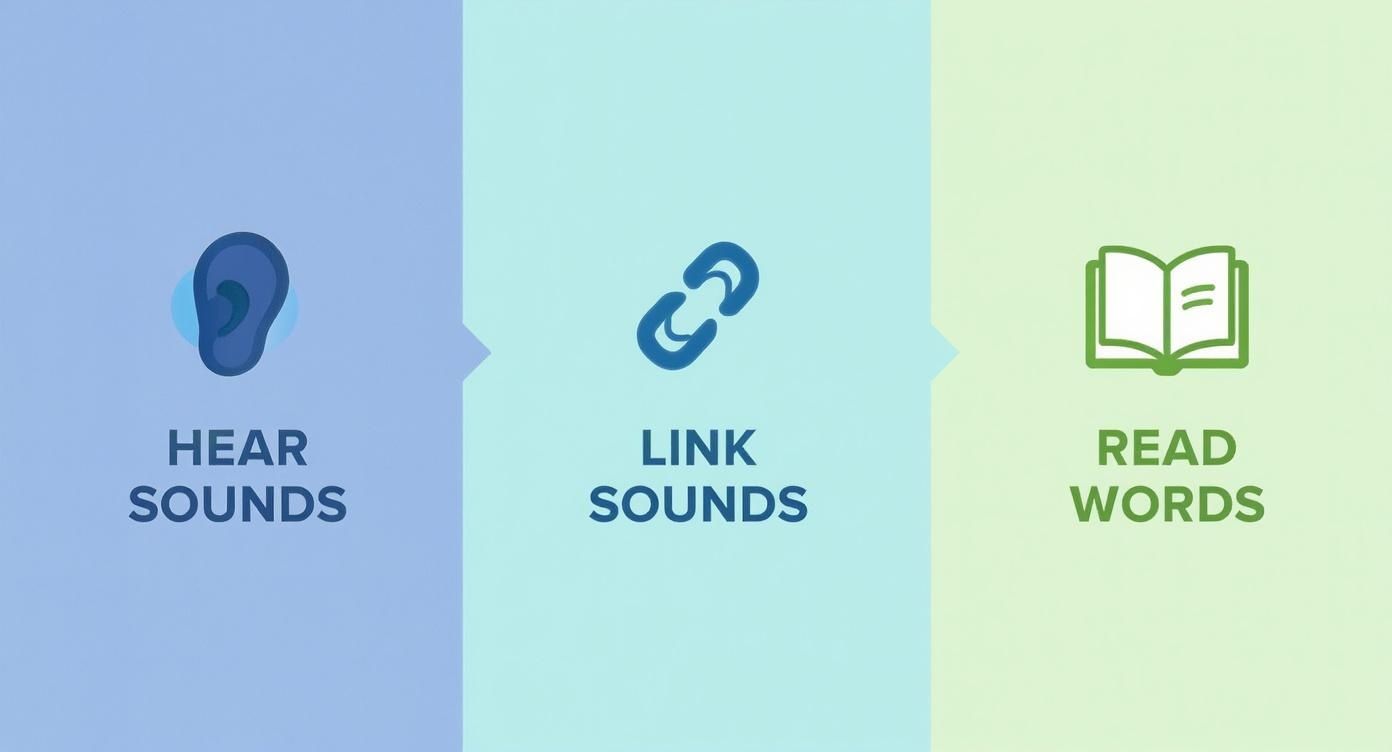
This whole process is built on a foundation of listening. You have to hear it before you can read it.
To help map out this journey, here’s a look at how phonemic awareness skills typically unfold.
Phonemic Awareness Skills Developmental Progression
Skill Level | Skill Name | Description | Example Activity |
|---|---|---|---|
Foundational | Phoneme Isolation | Identifying a single sound within a word (initial, final, then medial). | "What's the very first sound in the word pig?" Child says, "/p/." |
Intermediate | Phoneme Blending | Combining individual sounds to form a complete word. | You say, "/b/.../a/.../t/." The child blends it to say, "bat." |
Intermediate | Phoneme Segmentation | Breaking a whole word down into its individual sounds. | You say, "dog." The child separates the sounds: "/d/.../o/.../g/." |
Advanced | Phoneme Addition | Adding a new sound to an existing word to create a new one. | "Say lap. Now add /k/ to the beginning. What word is it?" (clap) |
Advanced | Phoneme Deletion | Removing a sound from a word to create a new word. | "Say clap. Now say it without the /k/ sound." (lap) |
Advanced | Phoneme Substitution | Replacing one sound in a word with another to form a new word. | "Say man. Now change /m/ to /p/. What's the new word?" (pan) |
This table isn't a rigid checklist but a helpful guide. It shows how skills build on one another, moving from simple listening to complex mental gymnastics with sounds.
Starting with Sound Isolation
The very first step is helping a child "zoom in" on one specific sound in a word. We always start with the initial, or first, sound because it's the easiest for little ears to catch.
You could ask, "What's the very first sound you hear in sun?" The goal is for them to respond with the crisp sound /s/, not the letter name "ess." Once they've got that down, you can move on to final sounds ("What's the last sound in mat?"), and finally, the trickiest of all—the middle sound.
A great tip I've used for years is to pick a "stretchy" word like 'mop' or 'fan'. Exaggerate that first sound—"mmmmmmop"—to help their ear grab onto it. It makes an abstract idea feel much more concrete.
Blending and Segmenting Sounds
Once a child can confidently isolate individual sounds, we move up the ladder to putting them together and pulling them apart. This is where you can really see the groundwork for reading and spelling being laid.
Blending is the reading skill. It's the ability to take separate sounds and smoosh them together into a real word. When you say, "/c/.../a/.../t/," and a child can blend it into "cat," they are getting ready to decode words on a page.
Segmenting is the spelling skill. It’s the reverse process: hearing a whole word and breaking it into its individual phonemes. If you say "hop," the child learns to pull out the three sounds: "/h/.../o/.../p/."
To practice blending, start small. Use two-sound words like in (/i/ /n/) or at (/a/ /t/). From there, you can move on to simple three-sound (CVC) words like cup.
To practice segmenting, bring in some movement! Have them tap their fingers or push a small block for each sound. For the word "fish," they would tap three times: once for /f/, once for /i/, and once for /sh/.
These two skills are two sides of the same coin and are absolutely essential for literacy.
Advanced Phoneme Manipulation
The peak of phonemic awareness involves playing with sounds in more complex ways: adding, deleting, and swapping them. These skills show a really high level of auditory processing and are usually mastered in late kindergarten or early first grade.
Phoneme Deletion: "Say the word smile. Now say it again without the /s/ sound." (mile)
Phoneme Addition: "Say the word tar. Now add /s/ to the beginning. What word do you have?" (star)
Phoneme Substitution: "Say the word bug. Now change the /b/ sound to an /r/ sound. What's the new word?" (rug)
When a child can do this, they have true phonemic proficiency. They can treat sounds like little building blocks they can move around at will. It’s an incredibly powerful tool that helps them tackle unfamiliar words and even self-correct their own reading errors down the line.
Fun and Practical Daily Phonemic awareness Activities

This is where all the theory turns into pure, simple fun. Forget worksheets and flashcards. The best way to build these critical listening skills is through short, playful, and frequent games woven right into your day.
The key is to keep it all verbal at first. Before a child ever lays eyes on a letter, their ears need to be tuned to hear and play with the sounds in spoken words. That auditory foundation is what makes phonics click later on.
Turn Everyday Moments into Learning Opportunities
You don’t need to block out "lesson time" for phonemic awareness. The best opportunities are the spontaneous ones—in the car, waiting for a snack, or during bath time. Your goal is to create a sound-rich world where playing with words is just a normal part of the day.
These activities take zero prep and can be adapted to any situation. Remember, five minutes of focused sound play every day is way more powerful than a 30-minute session once a week. It’s all about consistency.
Phonemic awareness instruction is so powerful because it works in these small, engaging doses. The research is clear on this. One major meta-analysis found a significant positive effect on students' skills, showing moderate gains in identifying, blending, and segmenting phonemes.
Let’s get into some practical games you can start playing today.
Sound Games for On the Go
These quick games are perfect for those in-between moments. They help kids tune their ears to the sounds happening all around them.
1. Sound Spy This is a simple twist on "I Spy" that focuses on a word’s very first sound.
How to play: Instead of spotting colors, you spot sounds. Say, "I spy with my little eye, something that starts with the sound /b/." Your child then looks around for something that begins with that sound, like a ball, a book, or a banana.
A little tip: Start with easy-to-hear sounds like /m/, /s/, /f/, and /b/. Save the trickier blends and vowel sounds for later.
2. Robot Talk (Blending) Blending is a huge pre-reading skill, and Robot Talk makes it a hilarious game.
How to play: Talk like a robot, stretching a word into its individual sounds. You might say, "Please pass the /s/.../aw/.../l/.../t/." Your child’s job is to put the sounds together to figure out the word ("salt!").
Try this: "Time to put on your /sh/.../oo/.../z/."
Hands-On Activities for Tactile Learners
For some kids, making sounds physical helps it all make sense. A few simple props can make an abstract idea like a phoneme feel real and manageable.
1. Sound Boxes (Elkonin Boxes) This classic activity gives kids a visual and hands-on way to break words into sounds.
What you'll need: A quick drawing of three or four connected boxes and some small tokens (coins, buttons, or LEGO bricks work great).
How to play: Say a three-sound word like "cup." As your child slowly repeats it, they push one token into a box for each sound they hear: /k/ (push one token), /u/ (push the second), /p/ (push the last). They can actually see the three distinct sounds in the word.
2. Sound Smash This is a high-energy version of sound boxes that kids absolutely love.
What you'll need: Three or four small balls of play-dough.
How to play: Say a word like "mop." For each sound your child hears, they get to smash one of the play-dough balls flat. For "mop," they'd smash one for /m/, one for /o/, and a final one for /p/. It’s multi-sensory and so satisfying.
Incorporate Rhyme and Rhythm
Rhyming is one of the first phonological skills kids develop, and it paves the way for hearing individual sounds. It helps them notice that words are made of smaller parts.
Rhyme Time: Make rhyming a casual part of your day. Ask, "What word rhymes with cat but starts with /b/?" (bat). This simple substitution game is a powerhouse for building these skills.
Silly Sentences: Make up sentences where most of the words start with the same sound. "Seven silly snakes sang songs." Ask your child to tell you the sound they hear over and over.
Nursery rhymes are another fantastic tool. The rhythm and repetition naturally train a child's ear to listen for sound patterns. For some great ideas, you can find a wonderful collection of 100 nursery rhymes with lyrics to share.
By weaving these simple, joyful activities into your daily life, you’re not just teaching a skill; you’re building a confident little learner who is ready for the exciting adventure of reading.
How to Structure Your Phonemic Awareness Lessons
When you’re teaching phonemic awareness, consistency is everything. I’ve found that short, playful, daily lessons build momentum and create lasting skills far more effectively than cramming everything into one long session. A simple, predictable routine helps you cover key skills systematically without ever overwhelming your little learner.
So, what does a great lesson actually look like? Forget about carving out huge blocks of time. The most powerful phonemic awareness instruction happens in quick, focused bursts. Your goal is a daily routine that feels more like a fun warm-up than a chore.
The Ideal Lesson Length and Frequency
This is one area where more isn't always better. The real magic happens with brief, consistent practice. I recommend aiming for about 10-15 minutes of dedicated sound play each day. That daily frequency keeps the skills fresh and gives young brains the constant reinforcement they need to make these abstract concepts stick.
And the research backs this up. One meta-analysis of over 1,000 students found a sweet spot for total instruction time: around 10.2 hours was the point of maximum effectiveness. Going beyond that didn't lead to significantly greater gains. This really highlights the power of short, potent, daily practice over long, infrequent lessons.
The takeaway for parents and teachers is simple: A little bit every day goes a long way. This consistent exposure is what builds true auditory mastery.
A Simple Framework for Your Daily Lessons
Having a predictable structure helps kids know what to expect and lets you move through skills efficiently. Think of your daily 10-minute session as having four simple parts that flow naturally from one to the next.
This framework provides a perfect mix of review, new learning, and playful application.
Quick Warm-Up (2 minutes): Start with something the child has already mastered. This builds confidence right out of the gate. It could be a fast-paced rhyming game or singing a favorite nursery rhyme with gusto.
"I Do" - Show Them How (2 minutes): Introduce the new skill for the day by modeling it clearly. You're the expert here. You might say, "Today, we're going to listen for the last sound in a word. Watch me. The word is bus. The last sound is /sssss/." Use hand motions or exaggerate your mouth movements to make the sound crystal clear.
"We Do" - Guided Practice (3 minutes): Now, try it together. "Let's do one together. The word is mop. What's the last sound we hear in mo-p?" Guide them to the correct sound, giving them as much support as they need. Work through a few more examples, slowly letting them take the lead.
"You Do" - Play a Game (3 minutes): This is where you lock in the learning. Turn the skill into a fun, low-pressure game. If you just practiced ending sounds, play a quick round of "Sound Spy" where they have to find objects that end with a certain sound. This independent practice confirms their understanding in a way that feels like pure fun.
The Million-Dollar Question: When to Introduce Letters?
One of the most common questions I get is about when to bring letters into these purely auditory lessons. And it’s a crucial one. At its core, phonemic awareness is an ears-only skill. The whole point is to train a child's brain to hear and play with sounds without any visual cues.
If you add letters too early, it can actually short-circuit the process. A child who is still struggling to hear the three distinct sounds in "cat" can get totally overwhelmed if they also have to remember the shapes and names of the letters c, a, and t.
First, build a rock-solid auditory foundation. Make sure your child can confidently do the skill orally—like isolating the first sound in a word—before you ever connect it to a letter.
Once they can instantly tell you the first sound in "sun" is /s/, then you can build the bridge. You can say, "Yes, the first sound is /s/! And this is the letter that makes that sound. It's the letter S." This approach connects phonemic awareness (the sounds) to phonics (the letter-sound connection) in a natural and powerful way, making reading feel so much more intuitive down the road. For more ideas on making learning fun, check out our guide on interactive storytelling.
How to Check Skills and Tackle Common Hurdles
So, you’re playing all these fun sound games. How can you tell if the skills are actually sticking? Good news: you don't need formal tests or quizzes. The best way to check is through quick, informal observations woven right into your daily play. Think of them as simple “sound checks” to see what’s clicking and where a little extra support might be needed.

Watching a child during a game is one of the most powerful tools you have. When you play "I Spy a Sound," are they consistently finding something with the right starting sound? During "Robot Talk," can they blend the sounds back into a word pretty quickly? Their natural participation gives you a real-time snapshot of their progress.
Another great method is a quick one-on-one check. While reading a book together, you might casually ask, "The word is bug. Can you tell me the sounds in bug?" This isn't a test; it's just part of the conversation. Their answer tells you everything you need to know about their ability to pull sounds apart.
What to Do When They Get Stuck
Even with the best activities, some kids will hit a roadblock. This is completely normal. The key is to spot these hurdles early and tweak your approach with specific, targeted strategies. Being responsive is just as important as the activities themselves.
Let’s look at a few common challenges and some simple ways to help.
Remember, the goal is progress, not perfection. A child struggling with a skill today might have a breakthrough tomorrow with a small change in how you present it. Stay patient and keep it playful.
They Can't Hear the Difference Between Similar Sounds
One of the first hurdles many children face is distinguishing between phonemes that sound almost alike, like /p/ and /b/, or /f/ and /v/. These sounds are made in a very similar way in the mouth, which makes them super tricky for little ears to tell apart.
The solution? Make the sounds physical and visual.
Grab a Mirror: Sit with your child in front of a mirror and say the sounds slowly. Let them see how your mouth looks when you make a /p/ sound (a little puff of air) versus a /b/ sound (no puff). Then, let them try it.
Feel the Vibration: Have them place a hand on their throat as they say the sounds. Voiced sounds like /b/ and /v/ will make their throat buzz. Unvoiced sounds like /p/ and /f/ won’t. This tactile feedback makes an abstract concept totally concrete.
They’re Struggling to Blend or Segment Words
Blending and segmenting are the power skills for reading and spelling, but they require some serious mental gymnastics. If a child can identify individual sounds but can't put them together or pull them apart, they might just need a little more scaffolding.
To help with blending (putting sounds together):
Stretch and Slide: Say the sounds in a word slowly and continuously, like you're stretching a rubber band: "sssssuuuunnnn." This helps them hear how one sound flows right into the next.
Start Small: Begin with simple two-sound words like up (/u/ /p/) or it (/i/ /t/). Once those are easy, move on to three-sound words.
To help with segmenting (pulling sounds apart):
Finger Tapping: This is a classic for a reason. Have your child tap a different finger for each sound they hear. For "cat," they’d tap their thumb for /k/, index finger for /a/, and middle finger for /t/.
Use Blocks or Buttons: Give them a few small objects. As you say a word like "ship," they can push one block forward for each sound: one for /sh/, one for /i/, and one for /p/.
By using these simple checks and targeted supports, you can keep a gentle pulse on their progress and offer the specific help each child needs to build that strong auditory foundation for reading.
Common Questions About Teaching Phonemic Awareness
As you dive into teaching phonemic awareness, it's completely normal for questions to pop up. It can feel a little tricky at first, but getting clear, straightforward answers makes all the difference. Let's tackle some of the most common questions I hear from parents and educators, so you can move forward with confidence.
What Is the Real Difference Between Phonological and Phonemic Awareness?
This is a big one, and it's easier than it sounds.
Think of phonological awareness as the big, broad umbrella of sound skills. It’s a child's ability to hear and play with the sound structure of language. This includes bigger chunks of sound, like recognizing rhymes, counting words in a sentence, or clapping out the syllables in a name like E-li-za-beth.
Phonemic awareness is a much more specific skill hiding under that umbrella. It’s the ability to zoom in on the tiniest individual sounds—the phonemes—inside a word.
A phonological skill is knowing that cat and hat rhyme.
A phonemic skill is knowing the word cat is made of three distinct sounds: /k/ /a/ /t/.
So, all phonemic awareness is a type of phonological awareness, but not all phonological awareness gets down to that tiny phoneme level.
When Is the Right Age to Start Teaching This?
You can start building the foundation much earlier than you might think. Fun, broad phonological awareness activities—like singing nursery rhymes and clapping syllables—are perfect for preschoolers around ages 3-4. These games train their ears to listen for sound patterns in a joyful, low-pressure way.
The more focused, direct work on individual phonemes (like blending sounds to make a word) becomes most critical in late preschool, kindergarten, and early first grade. We’re usually talking about ages 4 to 6. The key is to keep it playful and weave it into daily routines, not to drill young children.
Should I Use Letters During These Activities?
In the very beginning? A firm no. The whole point of phonemic awareness is to train a child's ear to hear, identify, and move sounds around in spoken words. It’s a purely auditory task.
Bringing letters into the mix too soon can confuse a child who is still working hard just to listen for the sounds. It's like asking someone to learn how to juggle and ride a unicycle at the same exact time. One thing at a time is best.
First, build a rock-solid auditory foundation. Once a student is confident with an oral skill, like isolating the first sound they hear in a word, then you can connect that sound to its letter. This creates a natural, powerful bridge from phonemic awareness to phonics.
How Long Should Our Practice Be Each Day?
When it comes to phonemic awareness, short, sweet, and consistent wins the race. Aim for just 10-15 minutes of focused sound play each day.
Research shows again and again that these brief, daily sessions are far more powerful than one long, weekly lesson. A little bit every day builds momentum and keeps the skills fresh. You can easily tuck these quick activities into your day—as a warm-up before reading, a game while waiting in line, or a fun way to wind down before a story.
At Once Upon A Memory Books LLC, we believe shared stories are the best way to build a foundation for literacy. Turn your family’s favorite moments into a beautiful, personalized storybook your child will want to read again and again, reinforcing the sounds and words they’re learning. Create your custom book today!