Blog
Create Your Own Board Book A Practical Guide to Keepsakes
Ready to create your own board book? This guide offers practical steps for turning your photos and memories into a beautiful, durable keepsake kids will love.
There's nothing quite like turning your family's everyday moments into a real, durable book your little one can hold. It’s more than just a sweet gift; you're creating a keepsake that helps build their love for reading right from the very start and shows them just how important they are.
Why Create a Custom Board Book for Your Child?
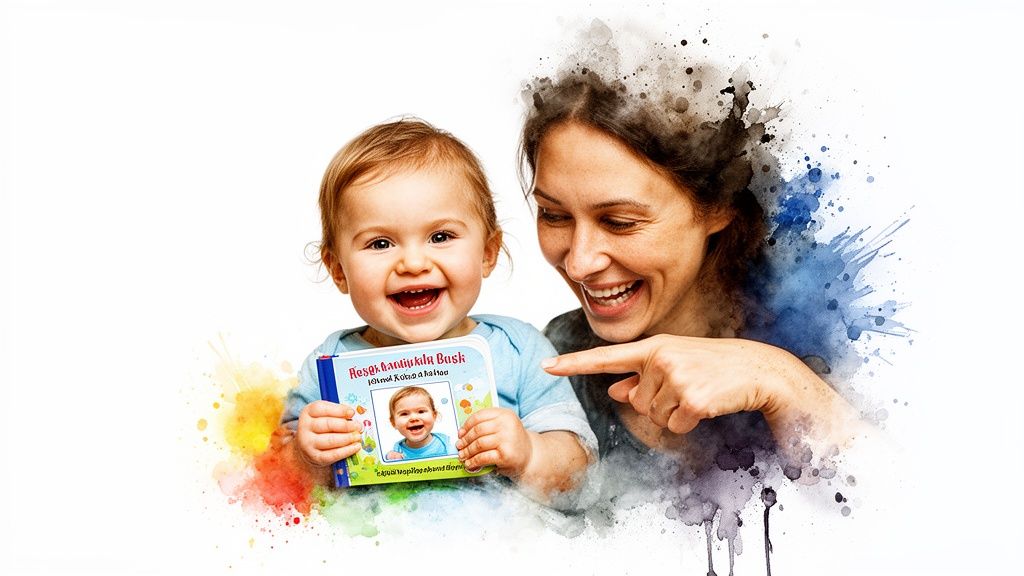
When you make your own board book, you're building a powerful little tool for connection and learning. A custom book filled with familiar faces and favorite places instantly grabs a child’s attention in a way generic stories just can't.
Imagine the pure delight when your toddler sees their own face, their grandparents, or the family dog as the hero of the story. That moment of recognition is incredibly powerful and helps them build a strong, positive sense of self.
Fostering an Early Love for Reading
Personalized books make reading an interactive, deeply personal experience. The story isn't about abstract characters; it’s about them, their world, and the people they love most. This simple shift turns storytime into a cherished ritual.
When books are tied to warmth, love, and fun from the very beginning, it lays the groundwork for a lifetime of literacy. Kids who see themselves in stories are naturally more engaged and curious to keep turning the pages as they grow.
A personalized story isn't just read; it's relived. Each page is a reminder of a happy memory, strengthening the bond between your child, the story, and you. It’s an experience that off-the-shelf books simply can't match.
Strengthening Family Bonds and Self-Esteem
A custom board book is like a tangible album of your family’s best memories. That messy trip to the park or a goofy family dinner becomes a real story they can understand and revisit again and again.
This process has some amazing benefits:
Boosts Confidence: Seeing themselves as the main character reinforces how important they are within the family. It’s a huge boost for their self-esteem.
Preserves Memories: It takes those fleeting photos off your phone and turns them into a durable heirloom that can withstand toddler hands (and mouths!).
Encourages Language Development: Hearing familiar names and routines helps toddlers connect words to their own lives, which can speed up their vocabulary growth. You can learn more about the benefits of personalized story books for kids in our detailed guide.
In the end, this is so much more than a cute project. It’s about creating a meaningful heirloom that builds a foundation for connection and learning that will last a lifetime.
Developing Your Board Book Story and Theme
Every great board book starts with a single, heartfelt idea. This is the fun part—where you get to turn your family’s inside jokes, favorite memories, and sweet little routines into a story that will light up your child's face. The secret is to pick a theme that feels deeply personal and makes sense in their little world.
What are the core experiences you share? Simple, focused concepts almost always make the best stories. A book called "A Day with Grandma," for example, could walk through the simple joys of baking cookies, snuggling up to read a story, and getting that perfect hug. Or "Our Camping Adventure" could show the thrill of setting up the tent, the fun of roasting marshmallows, and the magic of sleeping under the stars.
Finding Your Core Message
Before you even think about writing, take a quiet moment and ask yourself: What feeling or memory do I really want this book to hold? Your answer to that question is your theme. Maybe you want to capture the chaotic joy of a family vacation or celebrate the tender moment a big sibling meets the new baby.
If you're feeling stuck, here are a few themes that kids (and parents) always love:
Daily Routines: A simple story about bath time, bedtime, or a trip to the park.
Family Events: Celebrating a birthday, a special holiday, or a visit from far-away relatives.
Learning Concepts: Think "Our Favorite Animals," "Counting Our Toys," or "The Colors of Our Garden."
Big Milestones: A book about learning to walk, a first haircut, or starting daycare.
There’s a reason these custom stories are becoming so popular. The global children's picture book market is expected to grow from $12.34 billion in 2025 to a massive $21.68 billion by 2034. A huge part of that growth comes from parents wanting durable, meaningful books for their youngest kids. In fact, many U.S. families now set aside 15-20% of their children's book budget for custom creations. You can find more details on this trend over at forinsightsconsultancy.com.
Outlining a Toddler-Friendly Narrative
Once your theme is set, it’s time to sketch out a simple plot. Toddlers absolutely thrive on structure and predictability, so a clear beginning, middle, and end is your best friend. You don't need shocking plot twists or complicated drama; a straightforward sequence of events is exactly what their developing minds crave.
Let's take "Welcoming Baby Sister" as an example. The story arc could look like this:
Beginning: Show the family getting ready for the new baby—maybe a picture of setting up the crib or packing a hospital bag.
Middle: Capture that incredible moment the older sibling meets the baby for the very first time.
End: Finish with a heartwarming photo of everyone together at home, starting their new chapter as a bigger, happier family.
The most magical stories for young children often feature repetition and rhythm. Simple, predictable language helps them anticipate what's next, making reading an interactive and confidence-building activity.
The goal is to create a story that feels both exciting and comforting. For a deeper dive into structuring your story, check out our guide on how to create a children's book online. When you create your own board book, you’re not just telling a story—you’re preserving a piece of your family’s heart.
Choosing Photos and Writing Your Text
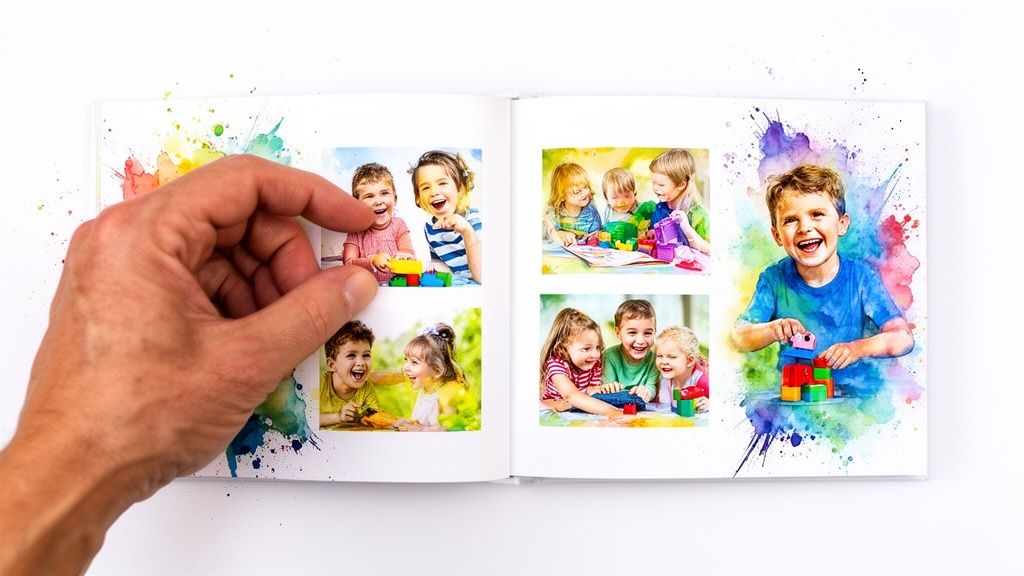
This is where the heart of your book comes alive. It’s the part where you pair those treasured photos with simple, loving words to create a story only you can tell.
Choosing the right photos is more than just finding cute pictures—it's about telling a visual story your little one can follow long before they can read. Look for bright, clear images that focus on a single subject.
Toddlers are wired to connect with faces, so prioritize pictures with big, clear expressions. Action shots are also gold. A photo of your child reaching for a toy or splashing in the bath has so much more energy than a static pose. The goal is to build a narrative with images alone.
Curating a Visual Story
Put on your storyteller hat as you scroll through your camera roll. You're looking for a mix of photos that set the scene, show an action, and capture an emotion.
For a book about a "Trip to the Zoo," you'll need more than just pictures of animals. Think about the whole experience:
The "Establishing" Shot: A photo of your child buzzing with excitement in their car seat on the way.
The "Action" Shot: A picture of them pointing at the monkeys or cautiously feeding a giraffe.
The "Close-Up" Shot: That beautiful, beaming smile that captures their pure joy.
This kind of personalization is why the interactive children's literature market is booming, expected to more than double from $2.35 billion in 2025 to $5 billion by 2035. And it makes a difference. Studies show personalized books can boost a child's vocabulary by 25% because they’re reread up to five times more often than other books.
If you have a story in mind but can't find the perfect picture, don't worry. Tools like an AI Art Generator can help you create custom illustrations to bring your vision to life.
Choosing the Right Photos for Your Story
This table is a quick guide to help you think through which photos will best tell your story.
Photo Type | What to Look For | Example Usage in Story |
|---|---|---|
Establishing Shot | Wide-angle, shows the environment | "Off to Grandma's house we go!" (photo of the car packed) |
Action Shot | Clear movement, interaction | "Splash, splash in the tub!" (photo of baby splashing) |
Close-Up/Emotional Shot | Expressive face, zoomed-in detail | "So sleepy... time for a nap." (photo of a big yawn) |
Relationship Shot | Interaction between two people | "Daddy gives the best hugs!" (photo of a warm embrace) |
Selecting a variety of shots like these will make your book feel dynamic and keep your little reader hooked, page after page.
Crafting Text for Little Ears
Writing for toddlers is a special art form. The secret? Simplicity and rhythm. Long, complicated sentences will fly right over their heads.
Aim for no more than 10-20 words per page. That's it. Keep the tone warm, loving, and consistent from start to finish. Use simple nouns and active verbs that are easy for little minds to grasp.
Instead of describing what’s happening in a photo, try to capture the feeling of the moment. For example, instead of, "Here is a picture from our vacation where you were enjoying the sandy beach," try something more rhythmic: "Splish, splash in the waves! We dig our toes in the warm sand."
Before: "This is when Mommy was holding you after you were born." After: "Hello, little one! Mommy holds you close. So much love."
See the difference? The second version is immediate, emotional, and memorable. You’re creating phrases your child will want to hear—and eventually say—over and over again.
For more tips on how to perfectly blend your words and pictures, check out our guide on creating children's personalized books with photos.
Designing and Laying Out Your Board Book
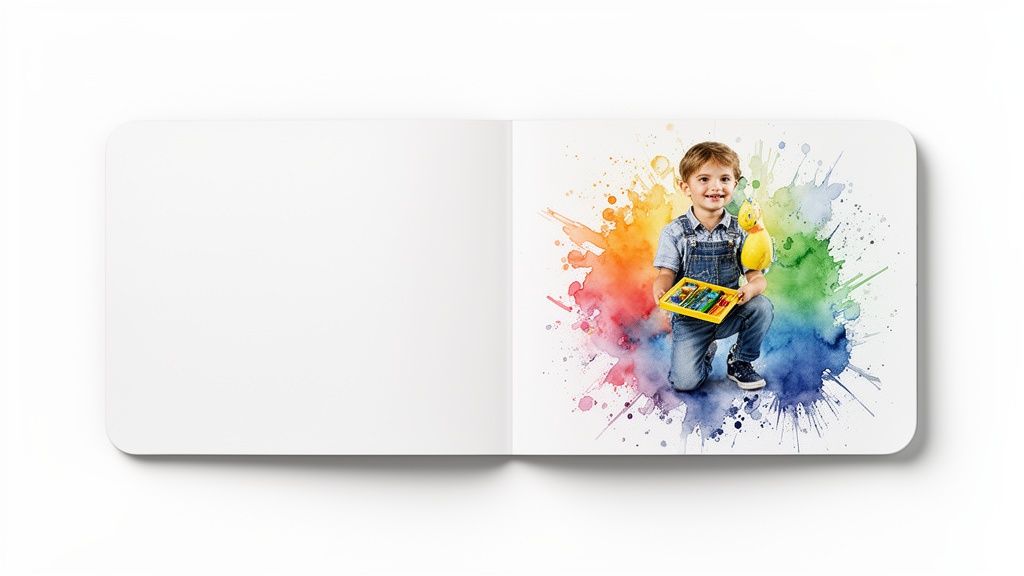
You’ve gathered your stories and photos—now for the magical part. This is where you bring it all together on the page, transforming a collection of memories into a beautiful little story that will captivate your child. The secret? Keep it simple, clean, and totally focused on their world.
You absolutely don’t need to be a graphic designer to create your own board book. In fact, some of the most engaging layouts are the most straightforward. Think clean, uncluttered pages with plenty of room for your photos and words to breathe. That "white space" is your best friend—it helps your child’s eyes go right to the good stuff: the familiar faces and simple words.
When it comes to the text, readability is everything. Little eyes are still learning, so choose fonts that are simple, clear, and easy to follow.
Creating Visually Appealing Pages
Think about contrast. Placing dark text on a light background (or the other way around) makes the words so much easier for toddlers to see and eventually recognize. It’s best to avoid busy, patterned backgrounds that can compete with your photos and make the text disappear into the page.
A great guide on how to create your own book cover actually has some fantastic design tips that work for the inside pages, too. While you're not just making a cover, the core ideas—like where to draw the eye and how to create a feeling—are just as important for hooking your tiny reader from the very first page.
This is where modern services like Once Upon A Memory really shine. Their smart tools often suggest layouts that are already optimized for little readers, so you get the benefit of great design without needing any experience. Of course, you still have total creative control to tweak every detail until it feels just right.
The best board book designs are intuitive. A child should be able to follow the story just by looking at the pictures, with the text serving as a warm, rhythmic guide that you provide.
Prioritizing Safety in Your Design
Beyond how it looks, the physical design must be safe for babies and toddlers. This part is non-negotiable, and it’s where using a professional service gives you serious peace of mind.
Here are the key safety features to look for:
Rounded Corners: Sharp corners are a real hazard for little ones who will absolutely explore the book with their hands and mouths.
Non-Toxic Materials: You have to be sure all inks and materials are certified non-toxic and child-safe.
Durable Construction: That book needs to survive chewing, drooling, and being turned by tiny, enthusiastic hands. The binding and pages should be thick and securely put together.
These are the kinds of safety standards that are automatically met when you use a dedicated service. It takes all the guesswork and potential risks out of the equation. By focusing on a clean, beautiful layout and trusting the pros with the physical production, you can be sure the book you create is not only special but completely safe for your child to love and explore.
You’ve poured your heart into the story and photos. Now comes the truly magical part: turning your creation into a real, physical book your child can hold, love, and probably chew on.
This final step is a big one. The way your book is made will determine everything—its sturdiness, its safety, and how long it lasts. Let's walk through the options so you can pick the right path for your family.
The Hands-On DIY Route
The most hands-on approach is, of course, a full Do-It-Yourself project. This usually looks like printing pages on heavy cardstock, maybe laminating them for extra protection, and then binding them together at home with rings or ribbon.
While this can be a really charming and personal craft project, it’s not always the best choice for a book meant for a baby or toddler. Homemade books just don't stand up to the grabby, drooly, page-turning reality of little readers. More importantly, it's hard to guarantee the materials are 100% non-toxic and safe for tiny mouths.
Going Pro: Why a Specialized Service is Different
For a keepsake that will truly last and be completely safe, professional printing is the way to go. But there’s a critical difference between a standard photo book you might order online and a true, durable board book.
A typical photo book has thin, papery pages. They’re great for a coffee table album, but they’ll rip in a heartbeat in a toddler’s hands.
A genuine board book is built differently. It has thick, unbendable pages laminated together, creating a tough little book that’s designed for rough handling. This is where a dedicated service like Once Upon A Memory comes in. They handle the complex, professional-grade printing and binding, making sure your book isn't just beautiful but also meets key safety standards with rounded corners and non-toxic materials. It’s what transforms your idea from a craft into a polished family heirloom.
Even in a digital age, the pull of a physical book is powerful. The global book market was valued at $136.23 billion in 2024, and get this—76.59% of all books sold are still hard copies. This just goes to show how much we still crave that tactile experience, especially for little ones. You can see more of these trends over at Fortune Business Insights.
Using a specialized service takes all the technical stress off your plate. You get to focus on the fun part—telling your story—while the experts handle the production to make sure a high-quality, safe, and durable book shows up at your door.
Board Book Creation Method Comparison
So, how do you decide which path to take? It really boils down to your end goal. Here’s a quick comparison to help you weigh the pros and cons between doing it all yourself and using a specialized service.
Feature | DIY Method | Specialized Service (e.g., Once Upon A Memory) |
|---|---|---|
Durability | Low. Pages can tear easily; binding may come apart. | High. Professionally bound, thick, laminated pages. |
Child Safety | Varies. Materials may not be non-toxic or drool-proof. | High. Built with non-toxic materials and rounded corners. |
Quality | Homemade look and feel. | Polished, professional-grade finish. |
Time Investment | High. Requires hours of printing, cutting, and assembly. | Low. Design online in minutes; production is handled for you. |
Ease of Use | Requires craft skills and special materials. | Simple, guided online creation process. |
Cost | Can be cheaper for a single project, but materials add up. | A clear, upfront cost for a professionally finished product. |
Ultimately, there's no single "right" answer, but seeing the differences side-by-side makes the choice clearer based on what matters most to you.
Making the Right Choice for Your Family
Choosing between a DIY project and a professional service comes down to what you want this book to be. Is it a fun, one-time craft activity, or are you hoping to create a durable family keepsake that can be cherished for years?
Timeline is another huge factor. A DIY book can easily eat up a whole weekend with cutting, pasting, and assembling. In contrast, services like Once Upon A Memory have the process down to a science, delivering a professionally finished book to your door in just 7-10 days. For busy parents, that speed and convenience is a game-changer.
When you create your own board book with a trusted partner, you get the best of both worlds: a completely personal story filled with your family's love, wrapped up in a professionally crafted book that’s truly built to last.
Got Questions About Making a Board Book? We've Got Answers
So, you've got this brilliant idea for a board book, but now the practical questions are starting to bubble up. That's completely normal. Moving from a heartfelt concept to a physical keepsake can feel a little daunting, but I promise, it's easier than you think.
We hear the same questions from parents all the time, so we’ve put them all in one place to give you clarity and confidence. Think of this as your cheat sheet for getting those final details just right.
This little flowchart is a great place to start. It can help you figure out if you're more of a hands-on, DIY crafter or if a dedicated service is a better fit for what you have in mind.
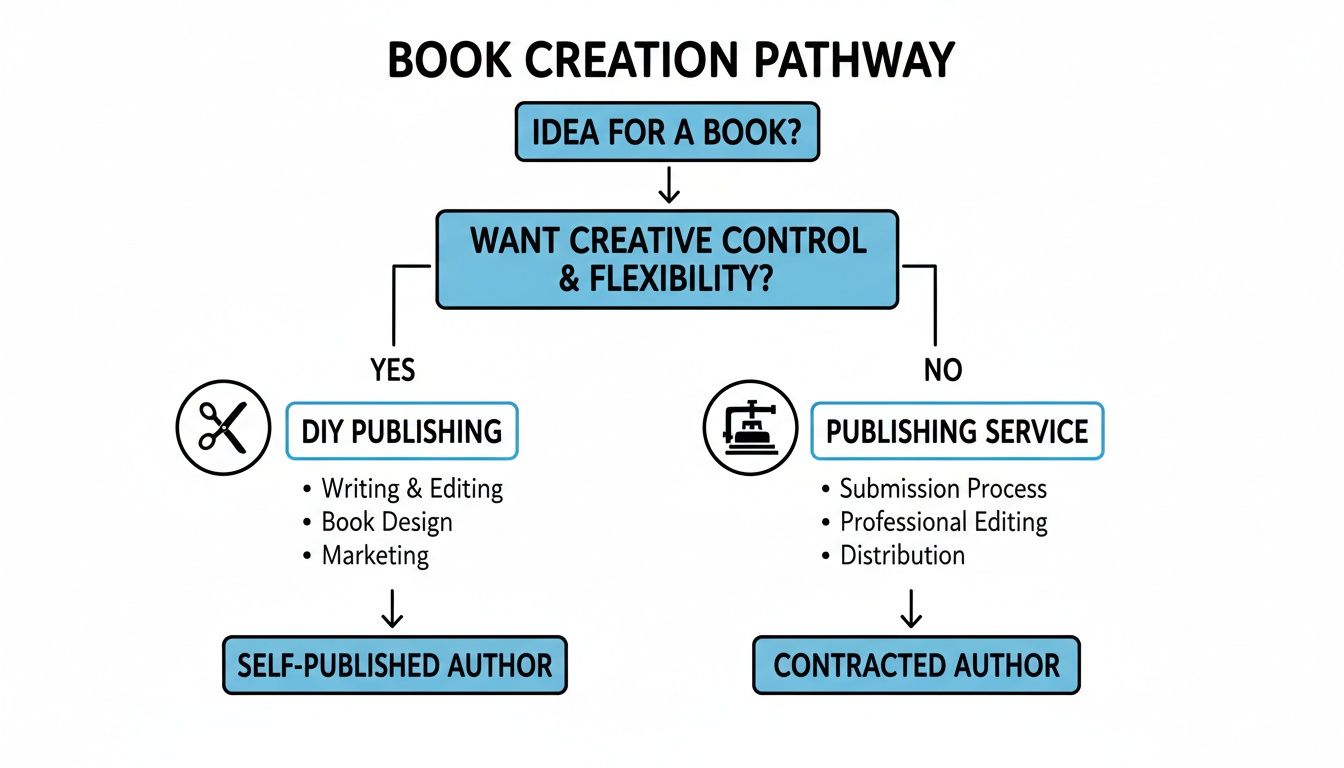
As you can see, the DIY route is all about the craft, while a service focuses on getting you professional, streamlined results without the guesswork. It all comes down to your priorities for quality, safety, and time.
Pages, Photos, and People
One of the first questions everyone asks is about length. How many pages are just right for a toddler's tiny attention span?
From my experience, 10-16 pages is the sweet spot for kids ages 0-3. That’s about 5-8 two-page spreads. It’s long enough to tell a simple, satisfying story but short enough that you won’t lose your wiggly audience before the final page.
Another big one: "Do I need professional photos?" Absolutely not. Most modern smartphone pictures are more than sharp enough for a standard 8x8 inch board book. What really matters isn't the camera, but the photo itself. Just look for images that are bright, clear, and in focus.
Pro Tip: Do a quick check before you upload. Zoom in on the photo on your phone or computer. If it still looks crisp and doesn't get all blocky and pixelated, it's going to print beautifully.
But what if you're making a book for two kids, like siblings or cousins? Easy. Just make the story about their shared experience. You could create a book called "The Miller Kids' Day at the Park" or "A Story for Sophie and Jack."
Here are a few simple ways to make sure both kids feel special:
Alternate the Spotlight: Dedicate each page or spread to a different child, giving them both their own moment to shine.
Focus on Togetherness: Choose photos where the kids are playing or interacting to highlight their bond.
Use Their Names: Address both children by name throughout the story. Hearing their own name is magic to a little one.
The Nitty-Gritty: Tech and Creative Choices
People often worry about copyright. Are your photos and story safe? Yes, 100%. When you use a service to create your own board book, you always keep full ownership of your content. You’re simply giving the company permission to print it for you.
Then there's the fun stuff, like fonts. It can be tempting to pick a swirly, whimsical font, but for little ones just learning their letters, readability is everything. Simple, clean, sans-serif fonts are always the best choice. Think Arial, Helvetica, or Century Gothic—they're classic, clear, and easy for developing eyes to read.
Finally, how long does this all take? If you go the full DIY route, you could be looking at a full weekend project, maybe more. But a huge plus of using a professional service is the speed. Once you've finalized your design online, you can have a polished, durable, and child-safe book arrive at your door in as little as 7-10 days.
Ready to turn those precious family memories into a beautiful book your child will adore for years? With Once Upon A Memory Books LLC, you can create a professional-quality custom board book in just a few minutes. Start creating your story today!